Building a Robust Firing Curve: Understanding Ceramic Firing Temperature Ranges
Firing curves define how unfired (green) bodies respond to heat during moisture removal, organic burnout, and early sintering, forming the basis for scalable, repeatable, and robust firing performance. Ramp rates, hold times, oxidation vs inert atmosphere, and airflow patterns influence microstructure and heat-work stability. The sections below outline the temperature intervals used in industrial firing.
Ceramic Firing Temperature Ranges
Below is a simplified ceramic firing temperature chart summarizing broad thermal intervals used in industrial firing:
| Thermal Interval | Typical Range (°C / °F) | Process Notes |
| Initial Heating | Ambient to ~200 °C (~392 °F) | Moisture removal and airflow control |
| Binder Burnout | 200 – 600 °C (392 – 1112 °F) | Burnout of organics and chemically bound water |
| Sintering Onset | 600 – 1100 °C (1112 – 2012 °F) | Start of shrinkage and particle bonding |
| Peak Firing Zone | Formulation dependent | Final densification based on heat-work |
Ceramic bodies pass through several thermal regions, each with its own constraints.
Initial Heating Zone (Ambient to ~200 °C)
This range removes free moisture and residual equilibrium moisture that remains in the body after ambient drying. Industrial bodies often retain 0.2 – 1.0 percent moisture depending on clay content, ambient humidity, and hold time before loading. A controlled hold near 90 – 110 °C (194 – 230 °F) stabilizes evaporation and minimizes internal vapor pressure during subsequent heating. Draft management during this interval is important; periodic and shuttle kilns benefit from managed exhaust flow to carry moisture out of the load while avoiding excessive heat loss. Rotary kilns are a whole different scenario with initial temps hitting the product quickly at 600 – 900C.
Steeper ramps are possible when bodies have uniform green density and controlled thickness. Non-uniform forming introduces internal gradients that require moderated heating rates.
Binder Burnout Region (200 to 600 °C)
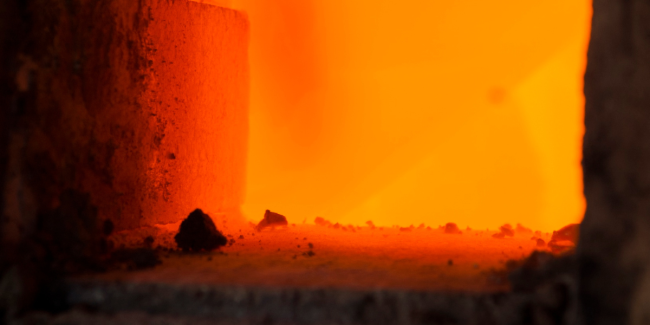
Organic burnout influences pore connectivity, internal pressure, and early-stage shrinkage. Before organic decomposition occurs, clay-based systems release structural water between roughly 450 – 600 °C (842 – 1112 °F). This dehydration contributes to internal vapor generation and interacts with binder decomposition if heating rates are excessive.
Higher binder loadings and pore-former additions require slower heating, typically 5 – 20 °C/hr. (9 – 36 °F/hr.) Airflow across the ware affects oxidative capacity. Kiln load density, setter configuration, and ware spacing influence how uniformly combustion gases escape.
Sintering Onset (600 to 1100 °C, formulation dependent)
Particle size distribution governs when neck formation begins. Fine powders (D50 < 5 µm) initiate sintering earlier due to elevated surface area. Coarser blends delay shrinkage and hold porosity open longer. Flux-containing formulations introduce partial liquid phases that accelerate shrinkage.
Advanced technical ceramics may need to reach 1600C and higher to sinter the various minerals such as alumina or non-oxide based materials. Time at peak temperature (soak time) may also be critical to reach the performance needed,
Engineering a Heating Rate Profile
Kiln configuration, airflow pattern, thermal mass, and loading strategy influence how heat reaches the ware. Production-scale firing often requires slower, staged ramps compared to lab furnaces to maintain repeatable heating behavior across large loads.
Practical Rate Guidelines
- Dense bodies: 25 – 150 °C/hr (45 – 270 °F/hr)
- High binder or pore-former content: 5 – 20 °C/hr (9 – 36 °F/hr)
- Thick sections (>25 mm): lower rates in all ranges
Dilatometry provides shrinkage curves that help identify the onset of sintering, maximal shrinkage rates, and risks for differential densification. Those data guide ramp adjustments that align heat input with the body’s reactivity. TGA/DTA or thermal gradient firings may also generate needed data as to when various onsets are taking place.
Burnout Control in Industrial Kilns
Incomplete burnout produces black cores, residual carbon films, bloating, and early-stage deformation. Burnout success depends on:
- Oxygen availability and distribution
- Binder chemistry and loading rate
- Pore connectivity formed during pressing or extrusion
- Temperature uniformity during the 250 – 500 °C (482 – 932 °F) range
Controlled holds at 350 – 500 °C (662 – 932 °F) allow exothermic decomposition to stabilize. Kiln furniture spacing should allow gas flow between setters. Airflow imbalances between zones often trace back to kiln pressure differentials or exhaust restrictions.
Validating a Firing Curve
Pyrometric cones provide direct evidence of heat-work received by the ware and serve as valuable supplements to thermocouple readings. Cone packs normally include:
- A guide cone that bends earlier than the target range
- A firing cone that corresponds to the desired heat-work
- A guard cone that protects against over-firing
Cone deformation patterns indicate localized deficits or excesses in heat-work and help identify airflow imbalance, loading variation, or zone-control deviations.
Reliable curves rely on measurable confirmation to support scalable production:
- Dilatometry for shrinkage progression
- TGA/DSC for binder decomposition signatures
- MOR testing to evaluate mechanical stabilization
- Dimensional repeatability across multiple kiln cycles
- Porosity, density, and permeability measurements for filtration and catalyst applications
Troubleshooting Thermal Instability
Common production issues include:
- Black core: insufficient burnout airflow or heating rate too steep
- Bloating: volatile entrapment in bodies with high organics or pore-formers
- Excessive warpage: uneven heat-work, setter distortion, or early liquid-phase formation
- Shrinkage mismatch: PSD variability or flux imbalance
- BET surface area and mercury porosimetry may also provide the needed date to reach product performance.
Plant teams should inspect loading patterns, setter flatness, press calibration, moisture variation, and raw material shifts to maintain a robust firing process. Most firing defects originate before the kiln cycle begins.
Learn More from the Experts at IntoCeramics
IntoCeramics supports manufacturers with firing-curve design, raw material evaluation, thermal analysis, and full ceramic engineering services. Plant teams seeking greater stability and throughput can contact our ceramics experts for process development, troubleshooting, and toll manufacturing support.
Contact the team today to learn more.