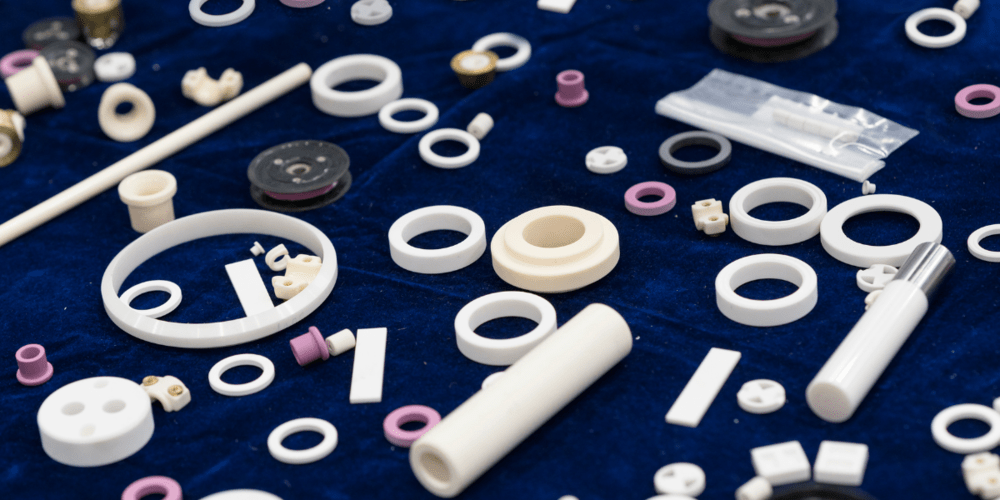
Alumina Ceramic: Processing, Properties, and Applications
Alumina ceramic material is widely used across industrial applications. This overview focuses on how alumina behaves in real manufacturing environments, where variability, defects, and throughput constraints influence final properties.
Overview of Alumina Ceramic Material
Alumina ceramic (Al2O3) is widely used due to its strength, chemical stability, thermal resistance, and electrical insulation. Commercial systems range from 85 wt% to >99.9 wt% purity, with properties controlled by impurity content, grain size, and processing.
In production, purity selection is often driven by cost and supply consistency. Small shifts in impurity content can change sintering response, affecting shrinkage and yield.
Fully densified material is alpha-alumina. Transitional phases convert above ~1100–1200°C depending on particle size and chemistry.
Typical density:
- 85–95% Al2O3: 3.4–3.7 g/cm³
- 99%+ Al2O3: 3.85–3.98 g/cm³
Powder Characteristics and Raw Materials
Powder properties control densification and defect formation.
Typical ranges:
- Particle size: 0.2–5 µm
- BET surface area: 1–10 m²/g
- D50: 0.5–3 µm
Finer powders reduce sintering temperature but increase agglomeration risk. In production, hard agglomerates often survive mixing and appear as residual porosity after firing.
Impurities (Na2O, SiO2, CaO) influence grain growth and liquid phase formation. In lower purity systems (≈90–96% Al2O3), silicate phases can promote liquid-phase sintering, improving densification but increasing shrinkage variability between batches. High-purity systems (>99.5%) rely on solid-state sintering with tighter control of grain growth.
Forming and Green Body Behavior
Common forming methods:
- Uniaxial pressing: 50–200 MPa
- CIP: 200–400 MPa
- Extrusion: 15–30 wt% binder
- Spray drying and granulation: controlled moisture and binder distribution for press-ready granules
- Slip casting: 60–75 wt% solids
Green density:
- Pressed: 50–65% theoretical
- Cast/extruded: 55–70%
In uniaxial pressing, density gradients are a frequent issue. These lead to lamination cracks or differential shrinkage that often only appear after firing. Spray-dried granule structure also matters, where hollow granules collapse unevenly. A common failure mode is edge cracking on ejection followed by exaggerated warpage after sintering due to these gradients.
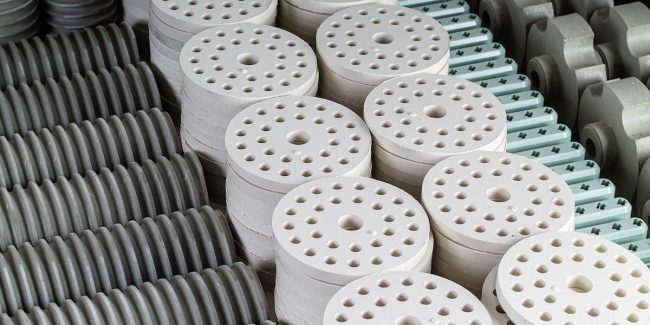
Binder Burnout
Binder removal typically occurs between 200–600°C.
Recommended profile:
- 0.5–2°C/min through burnout range
- Holds at 300–400°C and 500–600°C for thick parts
Rapid heating through 300–500°C commonly causes internal cracking in sections >10–15 mm. Gas evolution exceeds diffusion rates, leading to internal pressure buildup. Plants often misdiagnose this as press defects when it originates in the burnout profile.
Incomplete burnout results in residual carbon and trapped porosity, often showing up as bloating or inconsistent density during sintering.
Sintering and Densification
Typical conditions:
- 1500–1700°C
- 1–4 hour soak
- 3–10°C/min heating rate
Submicron powders densify at lower temperatures. Coarser powders require higher temperature and longer soak.
Above ~1600°C, grain growth becomes dominant. In production, long soak times (>2–3 hours) often reduce strength despite higher density. While alumina is typically fired in air, atmosphere control may be required when dopants or secondary phases are present, as oxygen partial pressure can influence grain boundary chemistry.
Kiln loading also matters. Poor airflow or dense stacking introduces temperature gradients, leading to uneven shrinkage. Setter interaction can also drive localized distortion, especially in thin sections.
Linear shrinkage: 15–20%
Variation is often driven by PSD or forming differences rather than firing temperature alone. Switching powder suppliers without revalidating PSD and agglomeration state is a common source of yield loss.
Porosity and Microstructure
Porosity directly affects performance:
- <1%: high strength (>300 MPa)
- 2–5%: improved thermal shock (with a corresponding reduction in mechanical strength)
- 20%: filtration applications
Closed porosity is more detrimental than total porosity due to trapped defects. Once pores become isolated during sintering, they are difficult to eliminate and act as strength-limiting flaws.
Engineered porosity uses pore formers (burnout 300–600°C). Poor dispersion leads to weak zones/uneven flow paths in filtration media.
Alumina Ceramic Properties
Mechanical Properties:
- Strength: 200–600 MPa
- Hardness: 12–20 GPa
- Modulus: 300–400 GPa
Thermal Properties:
- Conductivity: 20–35 W/m·K
- Use temperature: >1500°C
Electrical Properties:
- Dielectric strength: 10–20 kV/mm
- Resistivity: >10^14 ohm·cm
Batch-to-batch variation is often tied to microstructure consistency rather than composition alone.
Application Considerations
Alumina’s versatility comes from optimizing its purity and structure to specific environmental demands. Here is how those properties translate into industrial use:
- Refractories (High-Heat Linings): Uses 85–95% alumina with controlled porosity. The extra space between grains allows the material to expand and contract without cracking during rapid temperature changes (thermal shock).
- Electrical Insulators: Requires >99% purity and fine grain size. Removing impurities prevents electrical leakage, while a tight structure ensures the material can withstand high voltage without failing.
- Wear Components (Liners/Nozzles): Built with a dense structure and grain size <10 µm. Minimizing grain size makes the surface harder and more resistant to being worn away by abrasive materials.
- Filtration & Catalyst Supports: Engineered with 20–50% interconnected porosity. This creates a “sponge” effect, allowing liquids or gases to flow through the material while providing a large surface area for chemical reactions.
- Proppants (Oil & Gas): Created as spherical particles through spray drying. These tiny, high-density beads are pumped into rock fractures to hold them open under extreme underground pressure.
Processing Tradeoffs
Key tradeoffs:
- Finer powders vs. handling complexity
- Higher temperature vs. grain growth
- Binder content vs. burnout risk
In ceramic manufacturing, throughput often drives decisions. Faster cycles reduce cost but increase defect risk during burnout and sintering.
Consistent results require control of PSD, mixing, forming, and firing profiles. External process evaluation can accelerate improvements and reduce trial-and-error.
IntoCeramics Support for Alumina Processing
IntoCeramics toll manufacturing team supports alumina ceramic production through raw material selection, formulation, extrusion and granulation, firing optimization, and defect troubleshooting.
We work directly with plant teams to improve yield, reduce variability, and align material performance with application requirements.
Contact IntoCeramics to discuss alumina ceramic material challenges, process optimization, or new product development.