Ceramic Extrusion Process Explained for Manufacturing Scale
On the production floor, ceramic extrusion is as much a mechanical challenge as a materials challenge. Production systems have to deal with moisture swings, vacuum fluctuations, throughput changes, and raw material variation without losing dimensional stability. A body that runs fine one week can start tearing or laminating the next if moisture or feed consistency drifts too far.
What is Ceramic Extrusion?
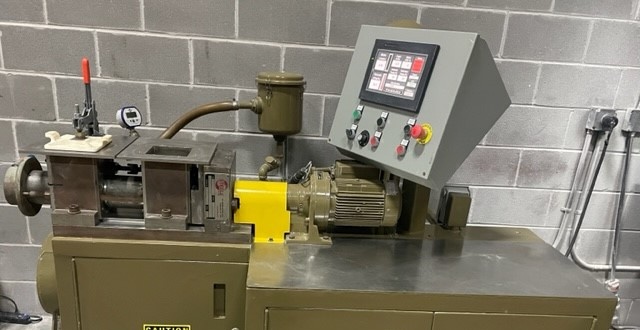
Ceramic extrusion is a forming method where a plasticized ceramic body is forced through a die to produce a continuous profile. The body formulation typically contains:
- Ceramic powders or mineral feedstock
- Water
- Organic binders
- Plasticizers
- Lubricants
- Processing additives
The material is mixed until it develops enough plasticity to move through the extruder without separating or tearing. Vacuum de-airing is normally used before extrusion to remove trapped air that later creates laminations or cracking during drying and firing. Production systems may run from several hundred psi to well above 3,000 psi depending on the material and die geometry. Honeycomb substrates, tubes, rods, and refractory profiles are all commonly produced this way.
Raw Material Selection & Feed Consistency
Raw material behavior usually determines how stable the extrusion process will be. Particle size distribution, particle shape, and mineralogy all affect water demand and plasticity. Fine powders normally require more binder and water, while coarse particles can reduce green strength and create surface tearing at the die exit.
In manufacturing, feed consistency is often harder to control than the equipment. Small changes in moisture content or clay chemistry can shift extrusion pressure enough to create dimensional instability. Experienced operators usually watch motor load, vacuum performance, and die pressure closely because those numbers often show problems before defects appear downstream.
Batch Preparation & Mixing
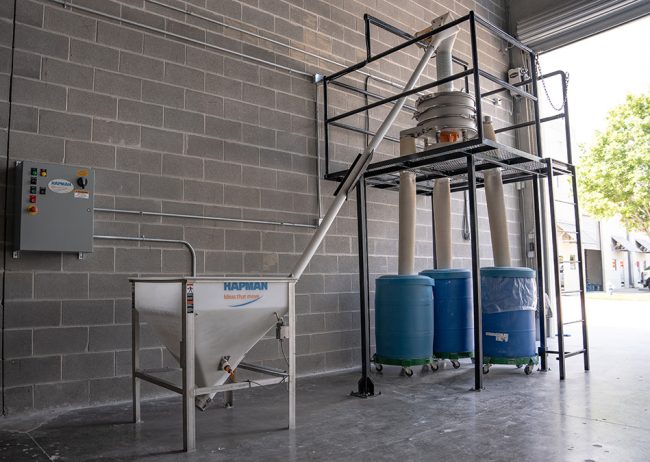
Batch preparation has a large impact on extrusion stability. Dry blending is usually done first to distribute additives before water is added in muller mixers, ribbon blenders, or pug mills. The process needs to produce:
- Uniform binder distribution
- Consistent material flow
- Controlled plasticity
- Consistent particle packing
Insufficient mixing leaves localized dry zones that later become cracking sites. Overmixing can generate heat and shift moisture distribution through the batch. Many extrusion systems also benefit from aging or soak time after mixing so moisture can equalize through the body. This step gets skipped more often than it should during development work.
Moisture Content
Moisture control is one of the more sensitive parts of ceramic extrusion. Production moisture may range from roughly 12% to 28% (depending on mineralogy and part geometry).
- Low moisture: Surface tearing, high extrusion pressure, laminations, excessive die wear
- High moisture: Slumping, dimensional instability, drying shrinkage variation
Small changes in incoming feed moisture can quickly shift extrusion behavior.
Vacuum De-Airing & Pugging
Entrapped air is a common source of extrusion defects. Vacuum de-airing systems remove internal air pockets before the material reaches the die. Residual air expands during firing and can cause bloating, blistering, laminations, or localized weakness. Spiral cracking and density gradients are also common when vacuum performance starts falling off.
Die Design & Extrusion Pressure
Die design affects both material flow and dimensional stability. Sharp transitions inside the die create high-shear areas that disrupt flow. Thin wall honeycomb structures are especially sensitive because pressure drop across the die face has to remain balanced.
As throughput increases, frictional heating inside the extruder can change moisture distribution and material behavior. Die wear also becomes a production issue in abrasive formulations containing alumina, silica, grog, or mineral fillers. Some operations go through dies faster than expected once production rates increase.
Drying & Firing Behavior
Drying is one of the higher risk stages in ceramic extrusion. The body contains moisture gradients that must be removed without creating excessive internal stress. Uneven drying usually leads to warping or edge cracking. Larger or more complex extrusions often need staged drying below 120°C (250°F) with controlled humidity and airflow.
Organic binders are normally removed between 200°C and 600°C (390°F to 1110°F). Large production kilns usually need slower ramp rates through burnout zones because thermal gradients become much larger at scale. Heating too fast through this range can trap carbon or generate internal pressure cracking. After burnout, sintering behavior depends on the material system, kiln atmosphere, and overall firing conditions.
Common Ceramic Extrusion Defects
- Lamination: caused by trapped air, inconsistent moisture, or poor weld flow within the die
- Surface tearing: associated with low moisture content, poor plasticity, or excessive pressure
- Warping: results from density variation or uneven shrinkage during drying
- Black coring: caused by rapid heating during binder burnout, trapping carbon in the core
Industrial Applications
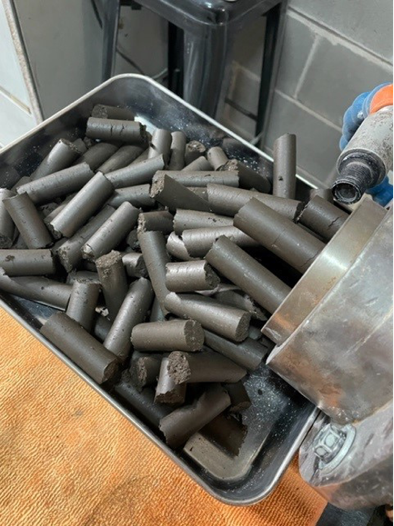
- Catalyst supports: cordierite systems extruded into thin-wall honeycombs for emissions control
- Refractories: extruded shapes for kiln furniture, furnace linings, and thermal processing
- Filtration media: porous ceramics for molten metal filtration or chemical processing
- Technical ceramics: alumina, zirconia, or fwassilicon carbide extruded into tubes and rods
Learn More About IntoCeramics’ Ceramic Extrusion Support
IntoCeramics provides process optimization and manufacturing scalability support for industrial ceramic and mineral based systems. We proudly offer:
- Toll manufacturing and granulation
- Waste stream mineral evaluation
- Upstream drying and milling support
- Production scale troubleshooting
- Ceramic consulting
- Analytical testing and formulation development
Contact IntoCeramics to discuss ceramic extrusion and ceramic manufacturing.