Temperature Converter for Ceramic Firing: Fahrenheit to Celsius
Ceramic firing schedules, kiln specifications, technical data sheets, and raw material information are not always reported in the same temperature unit. Use the formulas and charts below to convert Fahrenheit to Celsius or Celsius to Fahrenheit when comparing ceramic processing information.
Fahrenheit to Celsius Conversion Formula
Use this formula to convert Fahrenheit to Celsius:
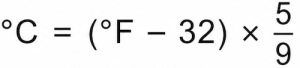
For example, a firing temperature of 2,300°F converts as follows:

Celsius to Fahrenheit Conversion Formula
Use this formula to convert Celsius to Fahrenheit:
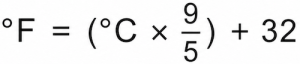
For example, 1,200°C converts as follows:

Ceramic Firing Temperature Conversion Chart
The following Fahrenheit-to-Celsius chart includes temperatures commonly encountered during drying, binder removal, calcination, sintering, and high-temperature ceramic processing. Converted values are rounded to the nearest degree.
| Fahrenheit | Celsius | Fahrenheit | Celsius |
| 200°F | 93°C | 1,800°F | 982°C |
| 300°F | 149°C | 1,900°F | 1,038°C |
| 400°F | 204°C | 2,000°F | 1,093°C |
| 500°F | 260°C | 2,100°F | 1,149°C |
| 600°F | 316°C | 2,200°F | 1,204°C |
| 700°F | 371°C | 2,300°F | 1,260°C |
| 800°F | 427°C | 2,400°F | 1,316°C |
| 900°F | 482°C | 2,500°F | 1,371°C |
| 1,000°F | 538°C | 2,600°F | 1,427°C |
| 1,100°F | 593°C | 2,700°F | 1,482°C |
| 1,200°F | 649°C | 2,800°F | 1,538°C |
| 1,300°F | 704°C | 2,900°F | 1,593°C |
| 1,400°F | 760°C | 3,000°F | 1,649°C |
| 1,500°F | 816°C | 3,100°F | 1,704°C |
| 1,600°F | 871°C | 3,200°F | 1,760°C |
| 1,700°F | 927°C |
Common Celsius-to-Fahrenheit Reference Points
| Celsius | Fahrenheit |
| 100°C | 212°F |
| 200°C | 392°F |
| 300°C | 572°F |
| 400°C | 752°F |
| 500°C | 932°F |
| 600°C | 1,112°F |
| 700°C | 1,292°F |
| 800°C | 1,472°F |
| 900°C | 1,652°F |
| 1,000°C | 1,832°F |
| 1,100°C | 2,012°F |
| 1,200°C | 2,192°F |
| 1,300°C | 2,372°F |
| 1,400°C | 2,552°F |
| 1,500°C | 2,732°F |
| 1,600°C | 2,912°F |
| 1,700°C | 3,092°F |
Where Temperature Conversions Are Used in Ceramic Manufacturing
Temperature conversion is commonly needed when:
- Comparing kiln or furnace specifications from different manufacturers
- Reviewing raw material and equipment data sheets
- Transferring firing schedules between facilities
- Establishing drying, binder burnout, or calcination schedules
- Comparing laboratory tests with pilot or commercial production
- Communicating process requirements with international suppliers and customers
- Reviewing historical production records that use another temperature unit
A unit conversion gives the equivalent numerical temperature, but it does not make a firing schedule transferable. Kiln design, load size, atmosphere, airflow, sensor location, and product geometry can all change the firing result.
General Temperature Ranges in Ceramic Processing
Ceramic processing temperatures vary with the formulation, product geometry, equipment, and targeted properties. These ranges provide general process context and should not be treated as firing recommendations.
| Process stage | General temperature region | Variables that affect the schedule |
| Drying and moisture removal | 200–400°F / 95–205°C | Body thickness, airflow, pore structure, and heating rate |
| Binder and organic removal | 400–1,200°F / 205–650°C | Binder system, body size, oxygen availability, and gas removal |
| Calcination and material reactions | 1,200–2,000°F / 650–1,095°C | Raw material chemistry, particle size, atmosphere, and time |
| High-temperature firing | 1,800–3,200°F / 980–1,760°C | Formulation, forming method, atmosphere, load, and desired properties |
Burnout schedules require more than a temperature conversion. Heating rate, body thickness, binder content, airflow, and available pathways for gas removal can all affect the result. A schedule developed with a small laboratory sample may need adjustment before it is used for larger shapes or production loads.
Temperature Conversion Does Not Account for Heat Work
Converting 2,300°F to 1,260°C establishes the equivalent temperature, but it does not show the total heat work received by the ceramic body. Peak temperature is only one part of a firing cycle.
Ceramic phase development, shrinkage, porosity, and strength can also be affected by:
- Heating rate
- Soak time
- Cooling rate
- Firing atmosphere
- Kiln loading
- Temperature uniformity
- Product size and geometry
- Thermocouple position
- Differences between kiln temperature and product temperature
For example, holding a body at 1,260°C for two hours may produce a different result than reaching the same temperature and cooling immediately. The added time can change shrinkage, density, porosity, phase development, and the way the body responds during cooling. This is why a converted temperature should not be treated as a complete firing schedule.
Pyrometric cones account for heat work by responding to both time and temperature. A cone designation should not be treated as one fixed temperature. Its bending point changes with the cone type and heating rate.
Practical Cautions When Converting Firing Temperatures
- Confirm the original unit before programming a kiln or furnace controller.
- Keep enough decimal precision when working within a narrow processing window.
- Distinguish kiln atmosphere temperature from the actual temperature inside the ceramic body.
- Check thermocouple type, location, calibration, and controller settings.
- Revalidate the firing cycle after moving production to different equipment.
- Treat laboratory results as a starting point for scale-up rather than a finished commercial process.
A correct conversion prevents a unit error. It does not replace process validation.
Need Help Developing a Repeatable Ceramic Firing Process?
IntoCeramics provides ceramic consulting for formulation development, firing evaluation, and process troubleshooting. We also offer manufacturing consulting for production scale-up and plant process improvements, along with toll manufacturing services for pilot and commercial production. Our ceramic manufacturing company can evaluate how raw material selection, particle characteristics, burnout behavior, firing atmosphere, heat work, and kiln conditions affect phase development and finished product performance.