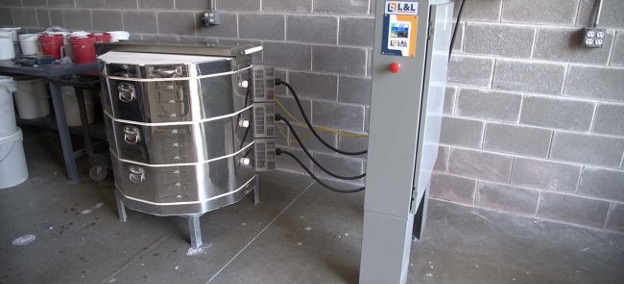
Sintering Process Optimization in Ceramic Manufacturing
What is sintering?
The sintering process is a high temperature densification step in which particulate ceramic bodies develop interparticle bonds, shrink, and reduce porosity. Material transport occurs through diffusion, with behavior governed by temperature relative to the melting point (T/Tm), particle size, and the chemical environment.
In production settings, operators rarely work in homologous temperature terms. Instead, densification is managed through kiln setpoints, ramp rates, and soak times. In general, bonding begins at lower firing ranges and transitions into rapid densification before grain growth begins to compete with pore elimination as heat-work increases.
Powder Characteristics and Green Body Preparation
Sintering outcomes are established long before the furnace cycle. Powder characteristics directly control packing, pore size distribution, and diffusion distances.
Particle Size Distribution (PSD)
- Powder is typically introduced as spray-dried granules (not loose particles) making granule size, strength, and breakdown behavior important
- Fine particles increase sintering driving force but can create agglomeration and flow issues
- Poor granule breakdown during pressing can lead to density gradients and residual pores
- Flowability and die filling behavior directly impact uniformity and defect formation
Surface Area
- Higher surface area increases sintering rate but also binder demand, solvent demand, and drying shrinkage
Green Density
- Uniform green density reduces differential shrinkage and distortion
- Compaction approach should be selected based on part geometry and material behavior
Binder and Additives
- Binder systems must support forming while allowing clean removal during burnout
- Granule strength and binder distribution affect die filling, compaction, and defect formation such as lamination or die sticking
- Plasticizers and lubricants reduce forming defects but must not leave residues
Binder Burnout and Thermal Debinding
Binder removal is a frequent source of defects. Incomplete burnout leads to bloating, cracking, or carbon residues that interfere with sintering.
Typical Burnout Approach:
- Slow controlled heating through binder decomposition ranges
- Staged holds to allow removal of organics without internal pressure buildup
- Controlled atmosphere to support oxidation or decomposition of binders
For thick or low permeability parts, extended holds may be required to prevent cracking/bloating.
Sintering Mechanisms and Stages
In practice, densification, pore elimination, and grain growth occur simultaneously rather than as clean, separate stages. Operators are typically balancing these effects across the entire load rather than observing discrete transitions.
- Early in the cycle, particles begin bonding with limited dimensional change
- As temperature and time increase, shrinkage accelerates and porosity becomes interconnected
- At higher heat-work, densification slows while grain growth continues, increasing the risk of trapped porosity
Most process control focuses on achieving sufficient densification before grain growth limits further pore removal.
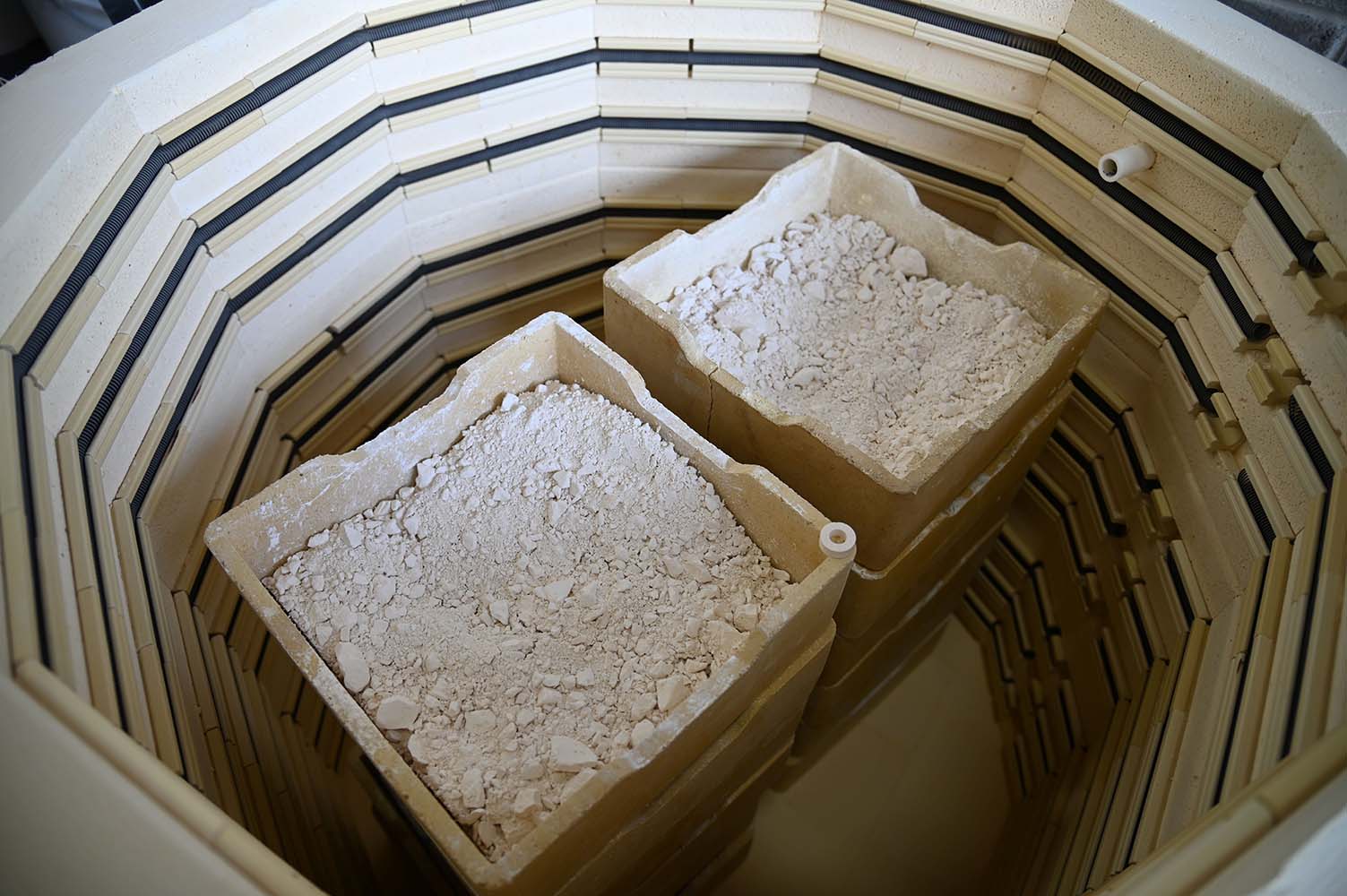
Temperature, Time, and Heat-Work
Sintering is governed by heat-work, not temperature alone. Equivalent densification can be achieved through different combinations of peak temperature and soak time.
Typical Industrial Ranges (Oxide Ceramics):
- Alumina (96-99.8%): 1500-1700 °C, soak 1-4 hours
- Zirconia (Y-TZP): 1350-1550 °C, soak 1-2 hours
- Cordierite: 1300-1450 °C with controlled phase development
Heating and Cooling:
- Controlled heating rates to limit thermal gradients and stress development
- Cooling profiles adjusted to manage phase transformations and avoid microcracking
Excessive temperature or time promotes grain growth, which can trap residual pores and reduce mechanical performance. Insufficient heat-work leaves open porosity and poor strength.
Atmosphere Control
Firing atmosphere affects phase stability, defect chemistry, and densification behavior.
- Air/Oxidizing: Standard for most oxide ceramics
- Reducing or inert environments: Used when phase composition or reactions must be controlled
Certain systems (e.g., iron bearing or zirconia based materials) can shift phase composition or stoichiometry under reducing conditions, affecting final properties.
Grain Growth and Microstructural Control
Grain size affects strength, toughness, dielectric behavior, and wear resistance.
- Fine, controlled grain structures are preferred for most high performance applications
- Additives such as MgO in alumina can limit abnormal grain growth and stabilize microstructure
Porosity Management
Porosity is not universally undesirable. The target depends on application and final performance requirements.
- Dense structural ceramics: < 2-5% porosity for strength and wear resistance
- Filtration media: 20-50% open porosity with controlled pore size (5-100 µm) for permeability
- Catalyst supports: High surface area with interconnected porosity for reaction efficiency
- Refractories: Tailored porosity for thermal shock resistance and insulation
- Proppants: Controlled density and strength through managed porosity
Pore size distribution is controlled through PSD, burnout behavior, and sintering profile. Rapid densification can close surface pores prematurely, trapping internal porosity.
Process Optimization Strategies
Industrial optimization requires balancing material chemistry with precise kiln control. While sintering aids or glass formers can lower peak temperatures to save energy, they must be used carefully to avoid compromising high temperature performance. Beyond chemistry, furnace uniformity is a non-negotiable factor, as consistent temperature across the entire load is the only way to ensure dimensional repeatability.
Ultimately cycle development should move away from standard recipes toward data driven profiles. By adjusting ramp rates and soak times based on actual shrinkage behavior, manufacturers can maximize densification without the grain growth or mechanical penalties that come from over-firing.
Learn More About IntoCeramics’ Thermal Processing Capabilities
IntoCeramics is a ceramic manufacturing company that provides toll manufacturing solutions such as calcining, ceramic sintering process development, and firing. We support powder pre-treatment, densification, and full firing cycle development, including management of burnout behavior, grain growth, and porosity evolution.
Contact IntoCeramics to discuss ceramic sintering process optimization along with toll processing and manufacturing consulting services!