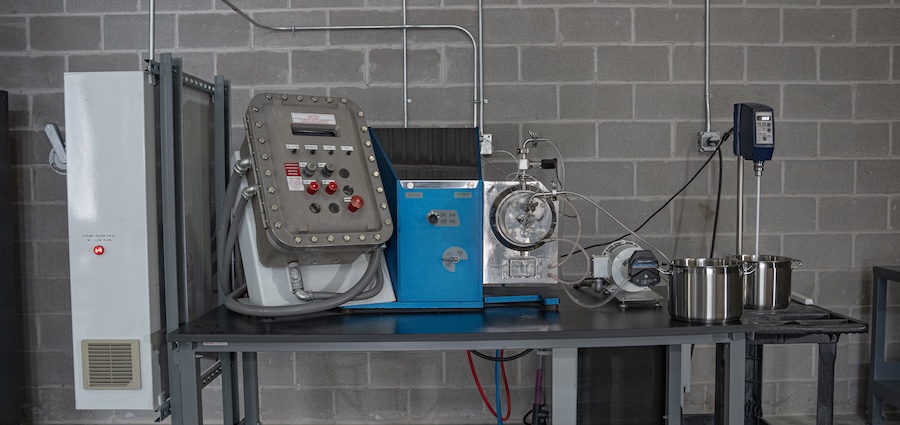
Ceramic Processing 101: Powder Preparation, Forming, and Firing
In production environments, ceramic processing is less about making a single laboratory sample and more about maintaining repeatability across thousands of pounds or tons of material. Refractories, catalyst supports, ceramic proppants, lightweight aggregates, and filtration media all require different combinations of particle packing, porosity, and thermal behavior.
In This Article
- Raw Material Selection and Powder Preparation
- Milling and Particle Size Control
- Binder Systems, Moisture, and Additives
- Ceramic Forming Methods
- Drying and Green Body Handling
- Ceramic Firing and Sintering
- Scaling Ceramic Processing for Manufacturing
Ceramic processing includes the preparation, forming, drying, and firing steps used to convert ceramic powders and mineral feedstocks into finished products.
Raw Material Selection and Powder Preparation
Ceramic processing begins with raw materials. Clay systems, alumina, silica, mullite, feldspar, zircon, kaolin, calcined minerals, industrial waste streams, and engineered additives each contribute differently to plasticity, sintering response, thermal expansion, and fired properties.
The powder preparation process will usually involve:
- Crushing and ceramic milling
- Classification and screening
- Moisture adjustment
- Granulation
Particle size distribution (PSD) directly affects packing density, forming behavior, and sintering response. Fine powders increase surface area and sintering activity but may also create dusting, agglomeration, and poor flowability.
Many ceramic systems use bimodal or multimodal PSDs to improve packing efficiency and reduce green porosity.
Powder preparation is also where many production problems begin. Inconsistent moisture, hard agglomerates, or unstable raw material chemistry can create defects that carry through the rest of the process.
Milling and Particle Size Control
Ball milling, attrition milling, and air classification are commonly used during ceramic processing to control PSD and particle packing.
In production operations, the target is usually a stable and repeatable PSD rather than the finest possible powder. Oversize particles can create die lines, laminations, or localized stress points, while unstable granule flow may produce density gradients that later appear as firing cracks or warpage.
Many ceramic manufacturers also use calcined materials during powder preparation to reduce shrinkage variability during firing.
Binder Systems, Moisture, and Additives
Most ceramic formulations contain temporary additives that support forming and handling prior to firing. Binder selection changes depending on the forming method, with extrusion systems typically requiring higher moisture contents than dry pressed systems.
Moisture content is one of the most tightly controlled variables in ceramic processing. Even small shifts in water addition can change extrusion pressure, green density, shrinkage, and cracking tendency. Poor burnout behavior may lead to:
- Black coring
- Blistering
- Carbon residue
- Internal cracking
Organic burnout commonly occurs between approximately 400°F and 1100°F (200°C to 600°C), often requiring slower ramp rates in thicker sections.
Ceramic Forming Methods
The forming stage converts prepared ceramic powder into a usable geometry before firing. Common ceramic forming methods include dry pressing, extrusion, slip casting, and injection molding. The forming method influences density distribution, shrinkage behavior, and final mechanical properties.
Dry Pressing
Dry pressing uses granulated powder compacted under pressure inside a rigid die. Typical forming pressures may range from approximately 5,000 to 30,000 psi depending on the material system and geometry. Uniform granule flow and die filling are important because density gradients introduced during pressing often become amplified during firing.
Extrusion and Granulation
Extrusion is widely used for honeycombs, catalyst supports, ceramic tubes, kiln furniture, and filtration products. Plasticity, moisture content, particle packing, and binder distribution strongly influence extrusion behavior.
Common production problems:
- Lamination
- Cracking
- Density inconsistency
- Poor green strength
Granulation and spray drying are commonly used to improve flowability and feed consistency before pressing or extrusion.
Drying and Green Body Handling
After forming, the ceramic body must be dried before firing. Drying removes free moisture while maintaining dimensional stability and avoiding stress development. Rapid moisture removal or uneven airflow can create:
- Edge cracking
- Warpage
- Differential shrinkage
- Laminations opening during drying
Controlled drying rates are especially important for extruded and highly plastic ceramic systems.In many operations, drying temperatures may range from approximately 150°F to 400°F (65°C to 205°C), depending on product geometry and moisture content.
Ceramic Firing and Sintering
Firing converts the fragile green body into a dense or partially dense ceramic structure through burnout, phase development, and sintering.
Many traditional ceramic systems fire between approximately 1800°F and 3000°F (980°C to 1650°C), although advanced ceramics may operate outside this range.
Sintering behavior depends heavily on particle size, surface area, green density, mineralogy, soak time, and firing rates. Higher firing temperatures generally increase densification, but excessive heat-work may also produce grain growth, bloating, deformation, or loss of controlled porosity.
For porous ceramics and filtration products, the objective is often partial sintering rather than maximum density.
Scaling Ceramic Processing for Manufacturing
Laboratory formulations do not always scale successfully into production. A ceramic body that performs well in a small batch may become unstable when processed continuously through industrial mixers, dryers, extruders, rotary kilns, or tunnel kilns.
Production scale ceramic processing introduces variables such as seasonal moisture variation, raw material inconsistency, thermal gradients, residence time variation, and throughput limitations.
Stable manufacturing requires balancing formulation chemistry with equipment capability and thermal behavior.
Questions? Speak with a Specialist at IntoCeramics.
IntoCeramics works with manufacturers, processors, and industrial operations across ceramic processing, mineral processing, extrusion and granulation, calcining, waste stream materials, and ceramic engineering. Our team also provides support for toll manufacturing and manufacturing business consulting services.
Contact our ceramic manufacturing company today to discuss ceramic processing in more depth.