What is Sieve Analysis? Principles, Applications, and Limitations
Particle size influences material flow, packing density, drying behavior, firing response, and finished product performance. One of the most widely used methods for measuring particle size distribution is sieve analysis. Despite the availability of modern particle characterization technologies, sieve analysis remains a practical tool for many ceramic, mineral, and aggregate applications.
What is Sieve Analysis?
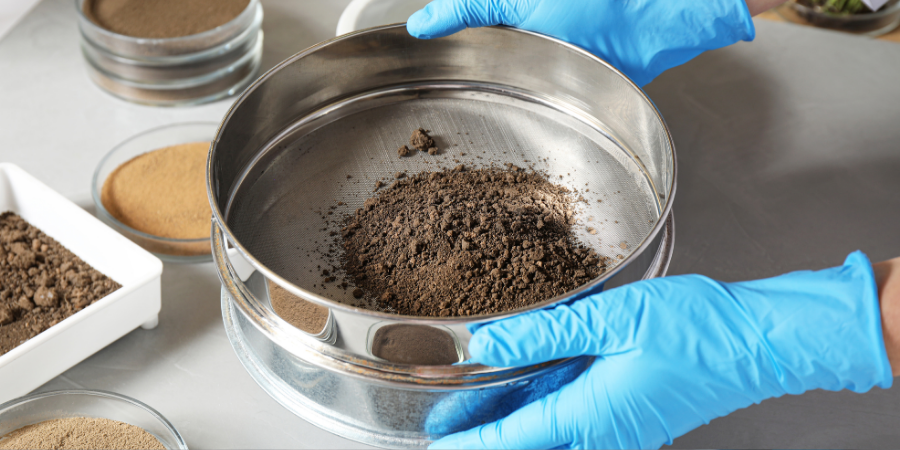
Sieve analysis is a particle size measurement method that separates material into size fractions using a stack of test sieves with progressively smaller openings.
A representative sample is placed on the top sieve and mechanically shaken for a specified period. Larger particles remain on the upper sieves while smaller particles pass through to lower sieves. The material retained on each screen is then weighed and reported as a percentage of the total sample.
The result is a particle size distribution showing how material is distributed across various size ranges.
In ceramic manufacturing, sieve analysis is commonly used for:
- Crushed minerals
- Granulated ceramic feedstocks
- Lightweight aggregates
- Ceramic proppants
- Recycled ceramic materials
- Calcined products
- Raw mineral feedstocks
The method has remained widely used because it is relatively simple and provides information that production personnel can quickly interpret.
What is the Purpose of Sieve Analysis?
The purpose of sieve analysis is to determine particle size distribution and verify that a material meets processing or product specifications.
Many manufacturing issues can be traced back to particle size variation. Material that is too coarse may not densify properly during firing. Material that is too fine may create dust handling problems, increase binder demand, or alter extrusion behavior.
Routine sieve analysis helps manufacturers:
- Monitor milling performance
- Verify incoming raw materials
- Control granulation operations
- Maintain product specifications
- Identify process drift
Changes in particle size distribution can affect forming behavior, drying performance, firing response, and final product quality. For that reason, sieve analysis is commonly used as a production control tool throughout ceramic and mineral processing operations.
How Sieve Analysis Works
A sieve analysis begins with obtaining a representative sample. This step is often more important than the actual testing.
If the sample does not accurately represent the bulk material, the results will have little value regardless of how carefully the test is performed.
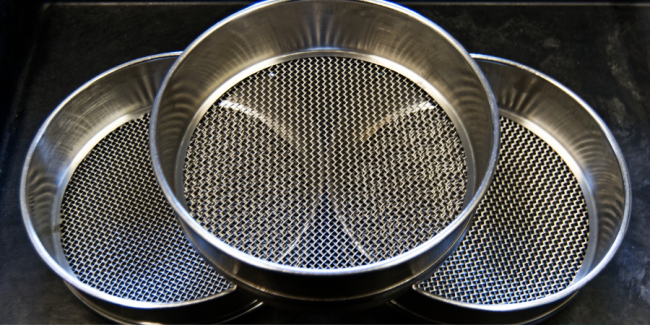
The material is placed in a stack of sieves arranged from largest opening to smallest opening. Typical testing may use anywhere from three to ten sieves depending on the desired resolution.
The sieve stack is then placed into a mechanical shaker and operated for a specified time, often between 5-15 minutes.
After shaking, the material retained on each sieve is weighed and recorded. These weights are converted into percentages to create a particle size distribution.
Results may be reported as:
- Percent retained
- Cumulative percent retained
- Percent passing
- Particle size distribution curves
For many industrial products, the percent passing a specified mesh size becomes an important production control parameter.
The test is typically performed using standardized ASTM or ISO sieves, a mechanical shaker, and a balance to measure material retained on each screen.
Applications in Ceramic and Mineral Processing
Sieve analysis remains particularly useful for coarse and intermediate particle size ranges commonly encountered in industrial ceramic production.
Granulation and Extrusion Feedstocks
Granule size distribution affects flowability, die filling, packing behavior, and moisture distribution. Oversized granules can create density variations while excessive fines may increase dust generation and alter forming characteristics.
Lightweight Ceramic Aggregates
Expanded aggregates are frequently classified using sieve analysis to verify product sizing requirements. Construction, geotechnical, and asphalt applications often require specific size fractions for proper performance.
Ceramic Proppants
Proppant products are sold within tightly controlled size ranges. Sieve analysis is routinely used to verify compliance with customer specifications and industry standards.
Crushed and Milled Minerals
Many mineral processing operations use sieve analysis to monitor crushing circuits, milling efficiency, and classification equipment performance. Changes in particle size distribution often provide an early indication that equipment settings or operating conditions have shifted.
Sieve Analysis vs. Laser Diffraction
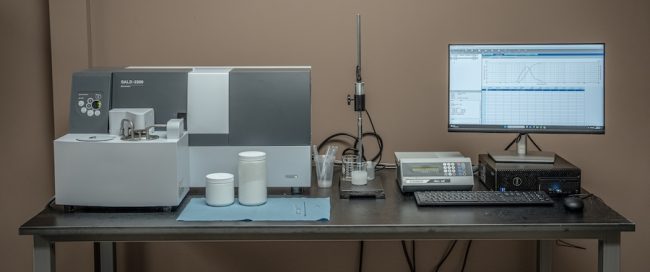
Many ceramic operations use both sieve analysis and laser diffraction because each method provides different information.
Sieve analysis is often preferred for:
- Granules
- Aggregates
- Proppants
- Coarse mineral products
Laser diffraction is often preferred for:
- Fine ceramic powders
- Calcined materials
- Spray-dried feedstocks
- Materials below approximately 45 µm
It is not unusual for two methods to produce different results on the same material. That does not automatically mean one method is wrong.
The important question is which measurement better reflects the way the material behaves in the manufacturing process.
In practice, sample preparation, moisture content, agglomeration, and testing conditions can all influence results. One common mistake is relying on a single test result without considering overall process performance.
Need Help with Ceramic Processing? Let’s Talk.
Particle size measurement is only one part of controlling ceramic manufacturing processes. Raw material selection, milling, granulation, extrusion, calcination, firing, and product testing all influence final performance.
IntoCeramics provides ceramic consulting, analytical testing, toll manufacturing support, process development, and manufacturing assistance for traditional and advanced ceramic applications.
Contact our team today to discuss.