Particle Size Measurement Methods for Ceramic Materials
Particle size influences nearly every stage of ceramic manufacturing, from how powders flow and pack to how they dry, sinter, and perform after firing. That’s why manufacturers measure particle size throughout production, not only when developing a new formulation. The right measurement method helps verify raw materials, monitor process consistency, and troubleshoot manufacturing problems before they affect finished parts.
No single particle size measurement method works for every ceramic material. The right technique depends on the material, the particle size range, and the manufacturing question being answered.
Why Manufacturers Measure Particle Size
Particle size gets checked at several points during production, not only during product development.
Raw materials are tested to verify supplier consistency before they enter production. Milling operations are monitored to confirm grinding performance without generating excessive fines. Particle size is also one of the first things many engineers look at when extrusion pressure increases, dust generation becomes excessive, or pressed and fired parts begin behaving differently than expected.
Once a formulation is running well, most plants establish a baseline particle size distribution (PSD) and monitor it over time. Small changes in that distribution often show up in production before they show up during final inspection.
Common Particle Size Measurement Methods
Sieve Analysis
Sieve analysis remains one of the most widely used particle size measurement methods for coarse ceramic materials.
Material is separated through progressively smaller mesh openings, allowing manufacturers to measure how much material is retained on each sieve. Because the particles are physically separated, the results are easy to interpret and compare from one production lot to the next.
Sieve analysis is commonly used for:
- Spray-dried powders
- Granulated feedstocks
- Crushed ceramic materials
- Ceramic proppants
- Refractory raw materials
- Lightweight aggregates
Sieve analysis becomes less effective as particle size decreases. Very fine powders may form soft agglomerates, pass through screens inconsistently, or simply be too fine for conventional sieves.
Laser Diffraction
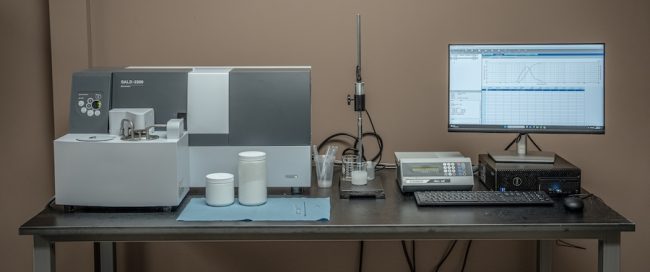
Laser diffraction is widely used for fine ceramic powders because it measures large numbers of particles quickly across a broad particle size range.
The instrument calculates PSD from the way particles scatter laser light. Results are commonly reported using values such as D10, D50, and D90.
Good instruments still produce poor data if the sample is not prepared correctly. Poor dispersion or soft agglomerates can make a powder appear much coarser than it actually is.
Laser diffraction is commonly used for fine ceramic powders, including alumina, zirconia, clay-based formulations, and other milled feedstocks.
Dynamic Image Analysis
Dynamic image analysis captures images of individual particles to evaluate size, shape, and aspect ratio. It becomes useful when particle morphology affects flowability, packing behavior, or downstream processing. In some cases, particle morphology explains manufacturing behavior that particle size measurements alone cannot.
Surface Area as a Complementary Measurement
Surface area testing does not directly measure particle size, but most ceramic engineers look at the two together after fine milling. Increased surface area influences binder demand, green strength, and sintering behavior. It often helps explain processing differences that particle size alone cannot.
Why Different Methods Produce Different Results
One mistake is comparing results from two different measurement methods as though they should match. They usually don’t because each method measures particles differently.
Particle shape, soft agglomerates, moisture, and sample preparation all influence the results. If sampling is inconsistent, the instrument often becomes secondary. Repeatable sampling and consistent test procedures are just as important as the measurement itself.
Which Particle Size Measurement Method Should You Use?
The most appropriate measurement method depends on the material being evaluated and the manufacturing question being answered.
| Material / Application | Common Measurement Method |
| Spray-dried granules | Sieve analysis |
| Crushed refractory feedstocks | Sieve analysis |
| Fine milled ceramic powders | Laser diffraction |
| Ultrafine powders | Laser diffraction with surface area testing |
| Particle morphology evaluation | Dynamic image analysis |
The best measurement method is the one that provides consistent, repeatable data for the manufacturing decision being made.
Particle Size Data Does Not Tell the Whole Story
Two powders may report nearly identical D50 values while performing very differently during manufacturing. One may contain more ultrafine particles that increase binder demand, while another may have a wider PSD that improves packing density.
Particle chemistry, mineralogy, particle shape, surface area, moisture, and processing history all influence manufacturing performance. Looking at those characteristics together usually provides a much clearer picture than particle size alone.
How Particle Size Influences Ceramic Processing
During mixing, finer powders generally require more binder or liquid because of their larger surface area. Wider PSDs often improve packing by allowing smaller particles to fill the spaces between larger ones.
The extrusion process usually tells you pretty quickly when particle size has changed. Die pressure increases, water demand changes, or surface finish begins to suffer. Pressing can also become less consistent if particle packing changes, leading to density variations before the parts ever reach the kiln.
During the sintering process, finer powders generally begin densifying at lower temperatures because their higher surface area provides a greater driving force for sintering. Excessive fines can also increase shrinkage and make process control more difficult.
What Changes in Particle Size Look Like on the Plant Floor
Production problems do not always point directly to particle size, but experienced process engineers know when it is worth checking.
A supplier may provide material that meets the same chemical specification as previous shipments while exhibiting a different particle size distribution. The chemistry has not changed, but drying behavior, firing shrinkage, or dimensional consistency may.
The same thing happens with recycled material. Every crushing and handling step changes the particle size distribution a little. Measuring that distribution before increasing recycled content usually produces more predictable manufacturing results.
Particle size rarely explains every production problem, but it often explains changes that chemistry alone cannot.
Improve Ceramic Manufacturing with IntoCeramics
IntoCeramics is a ceramic consulting company that manufacturers optimize ceramic manufacturing processes through raw material evaluation, process optimization, and manufacturing consulting. If particle size is affecting product quality, process consistency, or production efficiency, contact our team to discuss your project.